Make themwant itbefore it ships
A launch has one chance to impress. A page where people can turn the product, try its colours and pre-order on the spot turns attention into a waiting list — and the waiting list into sales.
What usually goes wrong
Photos that do not convince
A few static images cannot show a product people have never touched.
Buzz that fades
Launch traffic with no waiting list or pre-order is attention lost.
Specs nobody reads
Long tables hide the two numbers that matter.
Slow, heavy pages
Big visuals done carelessly make the page crawl on phones.
Built to win customers
Colour and options configurator
Pick colours and options and see the product change instantly, with the price.
360° turntable or 3D model
Turn the product in the browser — like the garage and T-shirt designers on this site.
Pre-orders and waiting list
Deposits or sign-ups with launch updates by email.
Specs that read well
The key numbers up front, comparisons and details for those who want them.
Motion that performs
Scroll animations and visuals optimised so the page stays fast on phones.
Press and dealers
A press kit, dealer finder or B2B enquiry form.
Kinvel One
Premium e-bike launch
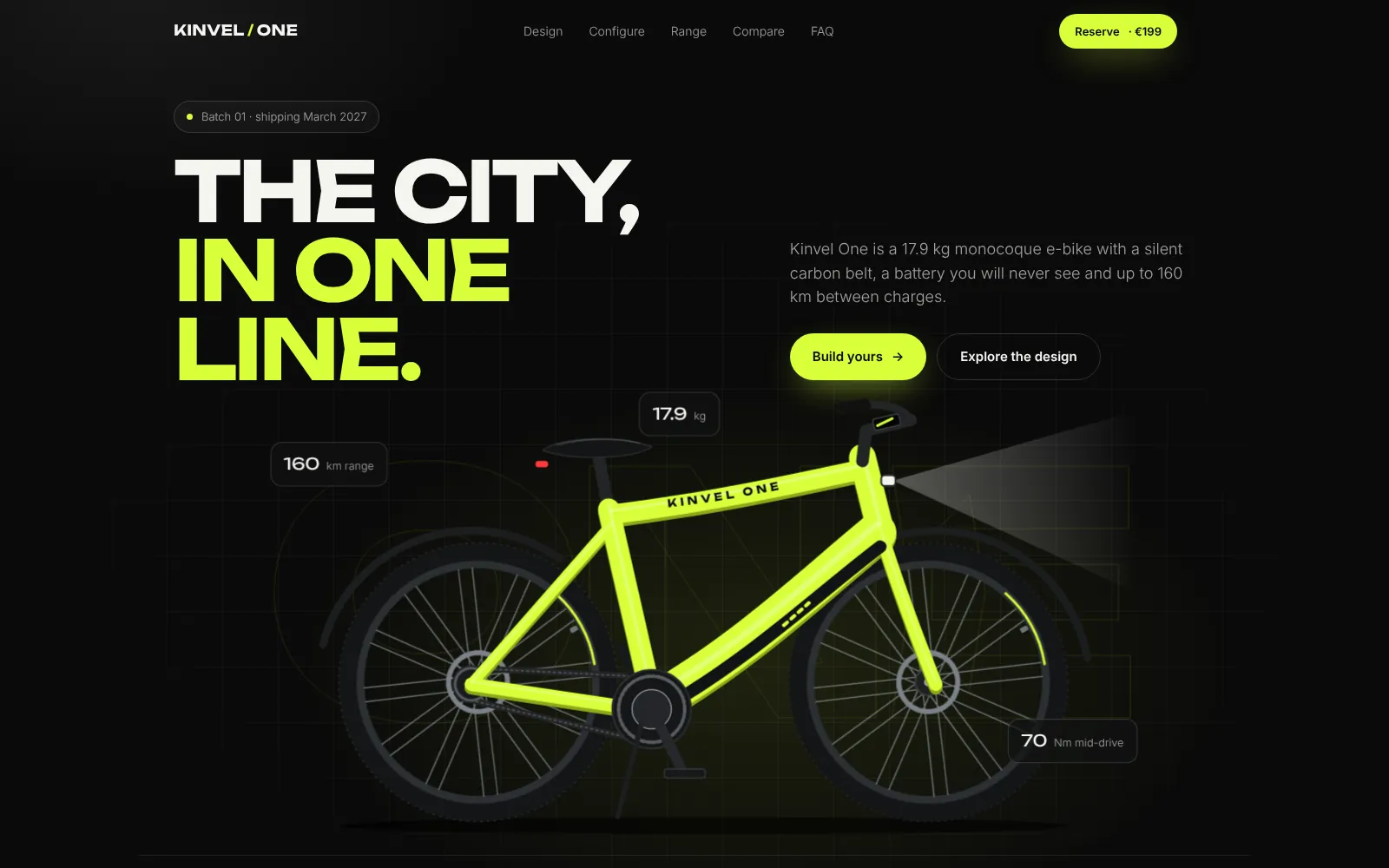
Kinvel One is a fictional premium e-bike launch: a colour configurator and a turntable that rotates the bike, specs that read at a glance and a clear path to pre-order.
What it costs
Launch landing page
One page with story, specs, gallery and waiting list.
With configurator
Colour configurator or 360° turntable, pre-orders, two languages.
Full 3D configurator
Real-time 3D model, options with pricing, orders and dealer integration.
Guide prices including design and development; the exact price comes in a written quote after a free consultation. How much does a website cost in 2026?
How it works
- 1
Free consultation
A short call about your business, goals and what you have today.
- 2
Written proposal
Scope, price and schedule in writing — no surprises later.
- 3
Design and build
Step by step, with previews you can click through on your phone.
- 4
Launch and care
Go live, a short handover, then support as you need it.
Frequently asked
Do we need a 3D model of the product?
For a real 3D configurator, yes — CAD files can usually be converted and optimised for the web. A 360° turntable works from a series of photos instead.
Can people pre-order or pay a deposit?
Yes, with online card payment, and the waiting list gets automatic launch emails.
Will heavy visuals slow the page down?
Not if they are built carefully: compressed models and images, loading only what is visible and animations that respect reduced-motion settings.
Can it become a full shop after launch?
Yes — the launch page can grow into a shop with accessories, financing and dealer search.
How long does it take?
A launch page takes about 2–4 weeks; with a configurator 6–10 weeks, so start well before the launch date.